Kemonaut: An Odyssey Class AUV Platform for the NEREUS Underwater
Mass Spectrometer
R. Camilli, MIT Parsons Laboratory Building 48-202, 77 Massachusetts Avenue
Cambridge, Massachusetts 02139
ABSTRACT
Kemonaut is an Autonomous Underwater Vehicle based on the MIT Sea Grant Odyssey
II design, incorporating a free flooding hull with three internal glass pressure
sphere housings, allowing the NEREUS submersible membrane inlet mass spectrometer
to be carried as payload in its forward bay. The vehicle-payload combination
weighs approximately 200 kg in air and is designed for operation in freshwater
and marine coastal environments to a depth of 300 meters. Composite structural
components, including carbon fiber laminates and high-density structural
foam, are used throughout the Kemonaut vehicle and NEREUS instrument to minimize
weight while maintaining adequate strength and vehicle stability. Stability
is further increased through asymmetric positioning of the glass pressure
spheres relative to the vehicle centerline. This design permits greatly expanded
vehicle payload capacity while preserving the Odyssey II hull shape and allowing
for the use of existing propulsion and control systems.
Sea trials have successfully demonstrated the vehicle and instrument configuration's
unique ability to autonomously measure multiple dissolved atmospheric gases
at ambient concentrations throughout the water column. Applications particularly
well suited for the Kemonaut-NEREUS configuration include pollution identification
and mapping to aid in remediation efforts, assessment of sub-surface natural
resources, and research on marine-related greenhouse gas cycling.
BACKGROUND
MIT Sea Grant's Odyssey Class autonomous underwater vehicles (AUVs) are
small, easily deployable, low component cost survey platforms, which have been
used in numerous missions throughout the world (Bellingham 1997). These vehicles
make use of low-cost mass produced hollow glass spheres, which commonly function
as full ocean depth floats, to house vehicle electronics, sensors and power
systems in a dry one-atmosphere environment, thereby permitting the use of
a free flooding vehicle hull and minimizing vehicle volume and displacement
requirements. However, the minimization of vehicle displacement makes the tradeoff
between range (i.e. power storage) and payload capacity a critical design consideration
(Bellingham, Goudey et al. 1994). The NEREUS membrane inlet mass spectrometer,
which is highly optimized to handle the difficult hotel function constraints
imposed by small autonomous underwater vehicles, is completely self contained
within an Odyssey compatible 17” glass pressure sphere, weighs 22 kilograms,
and operates to depths of 100 meters on a self contained power supply, drawing
less than 20 watts (Hemond and Camilli 2002). NEREUS uses an embedded autonomous
control system capable of adapting its mission directives and sampling regimes
to better monitor its environment. Operation of the NEREUS instrument onboard
an autonomous underwater vehicle enhances the advantages of in-situ analysis
of dissolved volatile chemicals by increasing the range and overall accessibility
of data collection areas. Furthermore, unlike other platforms such as moorings,
tow fish, and remotely operated vehicles, an AUV does not require a tether,
thus allowing a spatial survey to be conducted faster, follow bathymetry better
and operate in high sea states.
In August 2002, after having undergone successful limnologic and marine trials
as both a buoyed and towed sensor, the NEREUS instrument was ready for integration
into an Odyssey class AUV. At this time MIT Sea Grant's single remaining
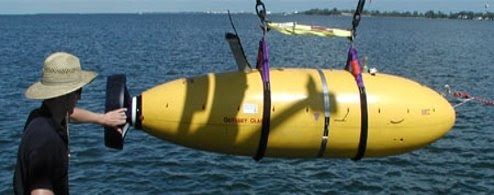
Odyssey II Xanthos vehicle (Figure 1) used both of its internal pressure spheres
to house vehicle power, control, and communication systems, making it physically
impossible to accommodate the NEREUS instrument without consolidation of the
components into a single sphere. NEREUS deployment aboard MIT Sea Grant's
newer
Sea Grant's Odyssey Class autonomous underwater vehicles (AUVs) are
small, easily deployable, low component cost survey platforms, which have been
used in numerous missions throughout the world (Bellingham 1997). These vehicles
make use of low-cost mass produced hollow glass spheres, which commonly function
as full ocean depth floats, to house vehicle electronics, sensors and power
systems in a dry one-atmosphere environment, thereby permitting the use of
a free flooding vehicle hull and minimizing vehicle volume and displacement
requirements. However, the minimization of vehicle displacement makes the tradeoff
between range (i.e. power storage) and payload capacity a critical design consideration
(Bellingham, Goudey et al. 1994). The NEREUS membrane inlet mass spectrometer,
which is highly optimized to handle the difficult hotel function constraints
imposed by small autonomous underwater vehicles, is completely self contained
within an Odyssey compatible 17” glass pressure sphere, weighs 22 kilograms,
and operates to depths of 100 meters on a self contained power supply, drawing
less than 20 watts (Hemond and Camilli 2002). NEREUS uses an embedded autonomous
control system capable of adapting its mission directives and sampling regimes
to better monitor its environment. Operation of the NEREUS instrument onboard
an autonomous underwater vehicle enhances the advantages of in-situ analysis
of dissolved volatile chemicals by increasing the range and overall accessibility
of data collection areas. Furthermore, unlike other platforms such as moorings,
tow fish, and remotely operated vehicles, an AUV does not require a tether,
thus allowing a spatial survey to be conducted faster, follow bathymetry better
and operate in high sea states.
In August 2002, after having undergone successful limnologic and marine trials
as both a buoyed and towed sensor, the NEREUS instrument was ready for integration
into an Odyssey class AUV. At this time MIT Sea Grant's single remaining
Odyssey II Xanthos vehicle (Figure 1) used both of its internal pressure spheres
to house vehicle power, control, and communication systems, making it physically
impossible to accommodate the NEREUS instrument without consolidation of the
components into a single sphere. NEREUS deployment aboard MIT Sea Grant's
newer Odyssey III Caribou vehicle was unlikely until spring of 2003 because
vehicle dynamics using a NEREUS payload section in combination with the vehicle's
vectored thruster and MOOS operating system were not well understood and because
delivery of a payload section from Bluefin Robotics was estimated to require
several months.
 Figure 1: Digaram of Odyssey IId Xanthos AUV (courtesy of MIT Sea Grant)
After lengthy analysis it was decided that a new type of Odyssey vehicle
could be built specifically for NEREUS missions at an economic and time
cost lower
than that of the Caribou center section or the Xanthos reconfiguration.
Design of this new vehicle, named Kemonaut, began in late October 2002 with
the goal of producing an operational vehicle before winter weather delayed
NEREUS deployment until the following spring. To speed the development process, it was determined
that the Kemonaut design should use an external hull, tail cone, control
and power system spheres identical to the Odyssey IId (Manley and Rieffel
2000). However, because the Kemonaut vehicle required space for three glass pressure
spheres (two for standard Odyssey IId power and control and one for the
NEREUS instrument) while retaining the same external dimensions of an Odyssey
II hull, a number of new design factors had to be addressed, including:
- increased vehicle displacement
- decreased hull stiffness
- decreased volume for core vehicle components
- decreased volume for floatation foam
- unknown vehicle center of buoyancy,
center of mass, and dynamics
- unknown navigation and communication system
interference from the NEREUS instrument
To further speed the design process, Kemonaut design plans
were developed on a computer using Solid Works CAD software,
allowing analysis work to be undertaken before vehicle components
were built and thereby minimizing the excessive time and
economic costs of iterative physical fabrication and construction
cycles.
DESIGN AND CONSTRUCTION
The design process began by first obtaining an Odyssey II
outer hull fairing From MIT Sea Grant's AUV Laboratory.
The fairing's diameter was then measured at 30 centimeter
transect intervals along its longitudinal axis. These dimensions
were then used to loft a computer model of the external hull
shape, which served as relative boundary volume for vehicle
components. Three 17” diameter spheres were then described
within this internal volume, yielding a residual volume for
all other vehicle components. To further increase clearance
between the 3 spheres, as well as overall vehicle stability
(lowering the vehicle center of mass) the glass pressure
spheres were asymmetrically positioned relative to the vehicle
centerline (Figure 2). In this arrangement the heaviest sphere
containing the vehicle battery supply was located in the
lower central position, the NEREUS sphere was located in
the forward position, and the vehicle control sphere was
positioned in the aft. This arrangement provided several
benefits, including:
- Additional volume in the upper section of the
hull is made available for floatation foam, further improving
stability
characteristics.
- Spacing between the vehicle's navigation and communication
systems and the NEREUS instrument is increased, thereby
minimizing electro-magnetic interference between vehicle
and NEREUS
systems.
- Distance between the two vehicle spheres and
the tail cone is minimized, thereby minimizing required
cable length.
- NEREUS sampling occurs before water is perturbed by the vehicle's
motion.
Despite the advantages of this arrangement, the layout
revealed that large sections of the Odyssey II structural
inner fairing would need to be removed in order to accommodate the third
NEREUS sphere, dramatically compromising the strength of
the inner hull. Furthermore, the additional 48 kg NEREUS
sphere would require greater hull strength than a standard
twin sphere Odyssey II layout.

Figure 2: Glass pressure sphere placement within the Kemonaut AUV
To prevent hogging or more severe structural failure leading
to possible pressure sphere damage during launch and recovery,
an additional hull girder was essential for improved hull
rigidity. However, the third sphere and an additional girder
significantly reduce available volume for floatation foam,
meanwhile requiring supplementary buoyancy to offset the
increased displacement produced by these new components.
Similar strength and mass constraints had previously been
confronted during development of the NEREUS instrument, leading
to the use of composite laminates and foams in its structural
elements. These materials functioned well in that they: reduced
component weight by approximately 80%, endured high shock
loads without failure during instrument deployments. In addition,
these materials are electrically and magnetically non-conductive
(a consideration when using fluxgate sensors), are generally
immune to corrosive sea water, and can be fabricated into
complex shapes relatively quickly and at low cost. Based
on the positive results met by the composite NEREUS components,
a computer design of a composite longitudinal girder was
developed to fulfill the structural requirements of the Kemonaut
vehicle. The contours of this surfboard-shaped component
allow it to occupy the normally empty four-inch gap, running
the length of the hull, between the upper and lower Odyssey
II inner fairings. To further reduce the vehicle's
floatation foam requirement, this girder design utilizes
marine structural foam (? = 288 kg/m3) sheathed in a carbon
fiber cloth (? = 1,570 kg/m3). The structural foam itself
possesses flexural strength (rise parallel to beam thickness)
of 4.8 MPa, while the autoclave cured carbon material possesses
a tensile strength of 448 MPa. Because the NEREUS instrument
is intended to operate to depths of approximately 100 m,
the structural foam was chosen as a compromise between the
high buoyancy but depth limited low-density foams and the
enormous depth capability of less buoyant syntactic foam.
The carbon fiber is an autoclave cured bi-directional (0°/90°)
33 msi 2x2 twill, layered to 1.5 mm thickness, which is impregnated
with an epoxy binding matrix, providing a measure of armor
plating for the foam as well as a large proportion of the
girder's rigidity.
Construction entailed creation of a plywood template to
pattern the contours onto the carbon cloth and structural
foam. These
materials were then cut to shape using a high-speed spiral
saw. After trimming, the upper and lower carbon fiber sections
were bonded to the central foam section and vacuum cured
using a small rotary pump and simple vacuum bag constructed
of trash bin liners. Autoclave curing of the carbon/foam
structure was not attempted, as it would have been deleterious
to the strength of the foam. External sides of the foam piece
were also sheathed in carbon cloth, but were bonded using
an epoxy containing glass microfibers to decrease brittleness
and thereby minimize the likelihood of delamination. Curing
was accomplished using the previously mentioned vacuum bag
technique. Cutouts for vehicle components were then made
to the girder after curing was completed. The resulting composite
structure has a mass of approximately 9 kg and is calculated
to withstand depths to 300 meters without significant compression
taking place and, due to the density of the foam, provides
approximately 16kg of floatation.

Figure 3: Exploded diagram of Kemonaut vehicle components
After fabricating the girder, the lower inner hull fairing
was modified to accept the third NEREUS sphere by excising
two sphere cradles from a surplus Odyssey II inner hull and
repositioning these further apart within a second Oddysey
II inner hull that was trimmed to accept the transferred
cradles. The third, central, sphere cradle was constructed
of a non-ribbed polyethylene Benthos “hardhat”.
Accurate positioning of the sphere cradles was necessary
because of the limited clearance between the spheres. Therefore,
to insure proper spacing, glass hemispheres were placed in
the cradles and aligned using the composite girder before
the sphere cradles were riveted into place with stainless
steel pop rivets.
A double-point lifting harness was designed instead of
the single-point system that Odyssey II vehicles use for
multiple reasons. First, adequate clearance was not available for
a single central lift point because of the location of the
center sphere. Second, two relatively wide-spaced lift points
would cause the vehicle's center of mass to reside
between the two points, allowing the vehicle to be lifted
without the vehicle experiencing the uncontrolled seesawing
common to the single-point harness. Third, by distributing
the loading between two attachment points, failure was less
likely to occur. After finalizing a computer design, the
lift frame was fabricated of 1/8”x 1” cross section
annealed #316 stainless steel bar stock and 1” diameter
stainless steel eyebolts.
Placements of those components residing outside of the
spheres were decided based on orientation requirements for
proper operation and computer generated clearance estimates. As
such, the sonar altimeter was positioned vertically between
the forward and middle sphere on the vehicle's starboard
side and a cutaway was made in the underside of the lower
hull to expose the altimeter's acoustic head. To help
equalize weight distribution, placement of the depth sensor
mirrored the sonar altimeter along the central axis, residing
on the portside between the forward and middle sphere. Careful
consideration led to vertical placement of the GPS Intelligent
Buoy (GIB) transponder in the nose of the vehicle, permitting
the transponder head to sit proud of the hull for clearer
signal transmission. The battery housing supplying power
to the strobe beacon was placed immediately forward and starboard
of the tail cone assembly in another attempt to aid balance
by offsetting the asymmetric girder cutaway required for the
tail cone assembly. The strobe light beacon, GPS antenna,
and radio antenna were mounted immediately aft of the lift
harness' rear eyebolt on top of a 3.5 inch diameter
cylindrical long-base-line (LBL) transducer that had been
permanently affixed to the upper hemisphere of the Xanthos
control sphere.
A modular three-piece floatation system was designed to
mount within the upper half of the vehicle between the middle
sphere
and outer hull to increase vehicle payload carrying capacity
and further improve stability. Six pieces of 3 1⁄2” thickness
pressure resistant marine foam (identical to material used
in the composite girder) were cut to track the hull shape using
dimensions derived from clearance estimates between the outer
hull fairing, lift harness, and pressure spheres. The four
forward-most pieces were then bonded together and coated with
an epoxy to improve durability, whereas the remaining two foam
pieces were coated with epoxy and cured separately. The large
4-piece section provides approximately 15 kg of buoyancy with
an additional 2 kg of buoyancy available through the inclusion
of each of the small single sections, thereby permitting buoyancy
adjustment according to vehicle-payload configuration. This
modular system, when combined with the composite girder, provides
between 31 and 35 kg of gross vehicle buoyancy when deployed
in freshwater.
CONTROL AND NAVIGATION
Vehicle control was made possible using the Odyssey IId
Xanthos tail cone assembly and control sphere. Both components
are powered using the central battery sphere which houses a battery
pack capable of generating 800 watt-hours of energy. The
tail cone assembly includes a propulsion unit powered
by a 100 watt
Pittman ELCOM series 5100 brushless thruster enclosed within
a cylindrical metal Benthos pressure housing in concert with
an elevator and rudder subassembly composed of two oil compensated
Pittman 3100 actuators individually directed by JR Kerr motor
controllers using Hall effect feedback sensors (Damus, Desset
et al. 2002).
Navigation is carried out through a simple open-loop system,
using a global positioning system and CrossBow AHRS (altitude,
heading and reference system composed of a 3-axis accelerometer
and magnetometer) contained within the control sphere, along
with a Data Sonics PSA-916 sonar altimeter and Paroscientific
Digiquartz pressure sensor (Damus, Desset et al. 2002). Data
from these sensors are supplied to the main vehicle computer
(MVC), a 300 MHz PC-104 stack, which uses MIT Sea Grant's
Mission Oriented Operating System (MOOS) and is located within
the aft control sphere. A FreeWave spread spectrum radio
modem housed in the aft sphere supplies communication between
the MVC and base station. This basic configuration allows
the vehicle to obtain position fixes and mission updates
by way of the radio transmitter and onboard GPS when the
vehicle is surfaced. While submerged, the MVC executes mission
directives using dead reckoning estimates via the AHRS, altimeter
and pressure transducer. The MVC automatically logs time
stamped MOOS data during both surface and submerged operation,
permitting post-mission analysis of vehicle operations and
time synchronized integration of vehicle track log data with
NEREUS chemical data.
ASSEMBLY
After fabrication was complete, the new 3-sphere inner structural
hull was fastened to the outer hull using stainless steel
screws. The tail cone assembly was then fitted to the external
hull, using a laser to align the thruster axis with the vehicle
centerline, and held in place with radially bored stainless
steel screws. Next the sonar altimeter and pressure transducer
were mounted in the lower hull with hose clamps banding their
housings to stainless steel L-brackets that are in turn bolted
to the inner hull. Desiccant packs were added to the pressure
spheres before sealing to prevent temperature-induced condensation
on internal electronic surfaces, then evacuated to approximately
0.8 atmospheres and placed within their appropriate inner
hull cradles. A small hull cutaway was made in starboard
bow to accommodate the NEREUS instrument's sampling
inlet and a low-cost engine coolant water intake guard was
then bolted in place over the cutaway to act as a guard for
the sampling inlet. Electrical wiring residing outside of
the pressure spheres were connected using waterproof wet
pluggable MIL-9 and coaxial cables. The composite girder
was then positioned on top of the lower inner hull, followed
by the upper inner hull, floatation foam and lift harness,
in respective order. These components were then secured in
place by eight stainless steel bolts, placed vertically along
the perimeter, with the four central bolts attaching to the
lift harness legs for load transfer, buttressed by two pairs
of bolts fore and aft to prevent hull separation. The top
outer hull was positioned and secured along its edge using
Zeus fasteners once all components were in place. Finally,
several small holes were drilled in the hull underbelly to
permit adequate water drainage during vehicle recovery.

Figure 4: Photograph of partially assembled Kemonaut,
showing the NEREUS instrument and composite girder
STABILITY AND BALLASTING
Prediction of Kemonaut's displacement and ballasting
requirements were made prior to construction using computer-generated
models of the assembled vehicle. The overall vehicle was
calculated to have a mass of nearly 185 kg and displace some
0.196 m3 volume, thus yielding a net buoyancy of about 15
kg in freshwater by assigning appropriate material density
characteristics to individual Kemonaut components. Modeling
and calculations also indicated that proper trim could be
achieved by placing 10 kg of lead weight in the aft portion
of inner hull immediately in front of the tail cone assembly,
along with approximately 4 kg of lead below the forward sphere,
producing a net 1 kg positive buoyancy in freshwater with
a center of mass located approximately 6 cm below the center
of buoyancy.
Initial ballasting was carried out on December 10, 2002
in the Upper Mystic Lake after the vehicle had been assembled.
At this time the lake surface had frozen to a thickness of
several centimeters, requiring that a hole be made in the
ice for ballasting. Using the Mystic Boat Club's facilities,
the vehicle was lowered by electric hoist into the water
to observe static buoyancy. Lead weight was then added iteratively
until the vehicle established approximately 1 kg positive
buoyancy and relatively neutral trim. A total of 15.4 kg of
lead weight was added to the vehicle, with 8.8 kg (two 10
lb lead dive weights) placed immediately forward of the tail
cone, 4.4 kg (one 10 lb dive weight) between the forward
and middle inner hull cradles, and two 0.9kg (2 lb dive weights)
on the port and starboard beam each. Based on this ballasting,
the vehicle was calculated to need between 3.6 and 5.4 kg
of additional ballast weigh for marine deployment.

Figure 5: Kemonaut ballasting in Upper Mystic Lake
MARINE DEPLOYMENT
On December 19 2002 the Kemonaut vehicle and NEREUS payload
underwent sea trials in Boston Harbor to demonstrate the cargo
carrying capacity, maneuverability, and overall seaworthiness
of the Kemonaut design as well as the ability of the NEREUS
instrument to collect meaningful chemical data while operating
onboard a moving AUV platform. A relatively confined region
of Boston's Inner Harbor near to the Charles River Locks
was selected for operations because of its unobstructed flat
bathymetry, relatively low frequency of boat traffic during
the winter months, and absence of underground tunnels or electrical
cables thereby avoiding potential electromagnetic interference
to the vehicle navigation system.
Operations began with the deployment of four GIB buoys
with attached hydrophones around the perimeter of the test
area. These buoys were positioned in more or less a rectangular
pattern to maximize the triangulation distance while minimizing
propagation path obstructions and interference with shipping
traffic. Rodes were anchored in place using a 5 kg weight
attached to 2 meters of 3/8" steel chain to prevent
drift in the channel's +1 kt current and 3.5 meter
tidal cycle.
Boston Harbor's Pier 4 served as the operations base
station for radio communication with Kemonaut and crew aboard
a skiff that served as an intercept boat. Operations base
station was setup in the cargo bed of a Ryder truck, parked
at the end of the pier to provide a clear view westward out
over the Harbor.
Kemonaut was ballast tested for marine deployment from
a two-ton electric hoist once GIB transponders were in position
and functioning. Based on results from earlier freshwater
ballasting, an additional 3.8 kg of weight had been fitted
to the vehicle while undergoing assembly in the lab. This
additional weight was distributed in two equally weighted
1.8 kg bags of lead shot. The first bag was zip-tie wrapped
to the 10 lb dive weight in the nose of the vehicle, and
the second weight was wired tightly to the external aft
surface of the vehicle, directly below the two 10 lb dive weights,
using 4 corrosive links. These corrosive links cause the
ballast weight to be jettisoned after a period of 12 hours,
thereby improving the prospects of successful recovery
in the event of a vehicle system failure. Although theoretically
buoyant for seawater, the vehicle proved to be correctly
ballasted without any additional weight. Salinity tests
confirmed the harbor water to be slightly brackish at 26-28 parts
per thousand, thus helping to account for the density disparity.
A small ~300 cc piece of floatation foam was added inside
the bow of the vehicle to achieve neutral trim.
Kemonaut and NEREUS clock synchronization and systems checks
were performed subsequent to ballasting. After satisfying
all checks, the AUV was released from its lift hoist and
towed into position using a 16 ft skiff equipped with a
35 hp outboard engine. Once in position, mission commands
were relayed to Kemonaut from the base station using the spread
spectrum radio modem and operations commenced once the
vehicle was in position.

Figure 6: Nautical Chart of Boston Harbor
showing GIB placement and overall area of operation
view an enlargement
Two initial surface missions were conducted to verify proper
vehicle tracking with the GIB hydrophone array, while maintaining
visual contact. Following the two surface runs, Kemonaut
performed a total of 6 submerged missions, ranging in duration
from 2 to 6 minutes and reaching a maximum depth of 6.3 meters.
Each dive mission was conducted as level, straight line,
run for a specified time duration with the aim of reducing
mission complexity and keeping AHRS error from critically
affecting the navigation system. The navigation system was
set to abort its mission if the vehicle's sonar altimeter
sensed a distance of less than 3 meters from the bottom to
prevent the vehicle from colliding with the harbor bottom.
The intercept boat tracked the submerged AUV using GIB hydrophone
position fixes of the vehicle relayed verbally over VHF radio
from the base station. After each dive the intercept boat
was sent to visually inspect Kemonaut for obvious signs of
damage and to prevent other nearby vessels from colliding
with the somewhat concealed AUV. In addition to visual inspection
after surfacing, NEREUS instrument status was evaluated via
a dedicated radio link from a laptop computer located in
the intercept boat. As a measure of caution, missions were
conducted verify proper vehicle tracking with the GIB hydrophone
array, while maintaining visual contact. Following the two
surface runs, Kemonaut performed a total of 6 submerged missions,
ranging in duration from 2 to 6 minutes and reaching a maximum
depth of 6.3 meters. Each dive mission was conducted as level,
straight line, run for a specified time duration with the
aim of reducing mission complexity and keeping AHRS error
from critically affecting the navigation system. The navigation
system was set to abort its mission if the vehicle's
sonar altimeter sensed a distance of less than 3 meters from
the bottom to prevent the vehicle from colliding with the
harbor bottom. The intercept boat tracked the submerged AUV
using GIB hydrophone position fixes of the vehicle relayed
verbally over VHF radio from the base station. After each
dive the intercept boat was sent to visually inspect Kemonaut
for obvious signs of damage and to prevent other nearby vessels
from colliding with the somewhat concealed AUV. In addition
to visual inspection after surfacing, NEREUS instrument status
was evaluated via a dedicated radio link from a laptop computer
located in the intercept boat. As a measure of caution, missions
were conducted at progressively deeper target depths of 2,
4 and 6 meters. Mission duration was also increased incrementally
from 2 minutes on first dive to a maximum of 8 minutes on
the sixth dive.

Figure 7: Kemonaut pressure transducer record
After satisfactory completion of its first and second dive
to respective depths of 2 and 4 meters, Kemonaut was requested
to dive to a depth of 6 meters on its third mission and
reached a maximum depth of 6.3 meters before resurfacing.
At the
time it was unclear if the bottom avoidance override
had been triggered
by an acoustic return from an obstruction lying on the
harbor bottom. Although later analysis of sonar altimeter
data revealed that this had not been the case, in the interest
of vehicle safety, a decision was made at that time to conduct
the next dive at a depth of 4 meters, but with an increased
mission duration of 5 minutes. Kemonaut executed this dive
mission cleanly by quickly rotating itself nearly 180° to
assume the proper heading and then maintaining its straight
course for the remainder of the mission, logging some 400
meters in distance. The fifth dive mission was setup to better
ascertain the repeatability of the vehicle's navigation
and control system by retracing this fourth dive. Consequently,
Kemonaut was towed back to the vicinity of its previous starting
position and instructed to dive to a depth of 5 meters for
a duration of six minutes using the same heading as dive
4. Again, Kemonaut performed capably, following to within
1 meter of its previous track line for a distance of over
200 meters. The sixth and final dive mission was intended
to further test the AUV's ability to maintain a straight
and level track line and to allow the NEREUS instrument adequate
time to collect multiple chemical spectra while at depth.
Mission duration was specified for 8 minutes and a shallow
depth of 3 meters was chosen in order to minimize the chances
of bottom collision. The desired heading was increased in
a similar attempt to prevent the AUV from being run aground
on the ruins near the harbor channel's southern sea
wall and Coast Guard piers. Despite these efforts, Kemonaut
was forced to abort the dive mission approximately 4 minutes
into the run because the assigned heading had inadvertently
overcompensated for the current, causing the vehicle to swim
northward, passing underneath the USS Cassin Young and a
barge before swimming into a shallow dry dock area, causing
the bottom avoidance override procedure to trigger, thus
forcing the vehicle to surface.
Based on recorded MOOS pressure sensor data, Kemonaut has
demonstrated a dive rate capability of up to 0.18m/s, and
is able to maintain a prescribed depth to within ±0.3
meters (Figure 7). Despite uncertainties caused by variability
in near-surface acoustic signal propagation, GIB hydrophone
tracking revealed that Kemonaut was able to maintain a high
degree of lateral accuracy (Figures 8 and 9). The extent
of Kemonaut's dynamic control is evident when comparing
the GIB track logs from dive missions four and five, particularly
in light of the fact that these dives were performed while
in the presence of a current with a flow rate exceeding 1.5
kts.

Figure 8: 2-dimensional GIB hydrophone surface track log of Kemonaut dive missions

Figure 9: 3-dimensional GIB hydrophone track log of Kemonaut dive missions
CHEMICAL DATA INTERPRETATION
The NEREUS instrument, which operated for the duration of
its time aboard the Kemonaut vehicle, collected approximately
90 individual spectra over the course of these three hours,
with each spectrum consisting of 693,000 discrete measurements.
The NEREUS instrument appeared to be largely unaffected
by vehicle motion through the water or vibration from the
vehicle's propulsion and control system while underway.
The NEREUS instrument conducted spectral scans of volatile
dissolved gases ranging in molecular weight from 12 to
150 Daltons while operating onboard Kemonaut. These scans
were
performed at a mass step interval of 0.1 Dalton to ensure
that ion peak shape could be clearly resolved. Signal averaging
was kept to 500 samples per data point in an effort to
minimize the amount of time required for a complete spectral
scan
while still maintaining an adequate S/N ratio. Automated
radio communications between the instrument and its remote
computer terminal (used for monitoring the instrument)
were scheduled to occur during the electrometer stabilization
period before the instrument took a measurement to further
decrease time requirements. NEREUS was able to complete
an
entire scan once every 98 seconds using these techniques.
Although spectral scans can be conducted much faster by
further limiting the mass-to-charge range, mass step interval
and
signal averaging, this mode was chosen so that high molecular
weight hydrocarbons could be clearly identified in the
event of being encountered by the AUV.
Post-deployment analysis of NEREUS data revealed the presence
of dissolved atmospheric gases, principally nitrogen, oxygen,
and argon (Figure 10). Due to the cold temperatures encountered
on this day (an air temperature of -5 to -1° C and a
water temperature of 2 to 4° C) the instrument's
inlet membrane permeability was significantly decreased,
causing all spectra to exhibit attenuated peak heights. Nevertheless,
relative ratios of these gases remained consistent with previous
NEREUS data collected during buoyed deployment in this area
of Boston Harbor. RMS noise was typically about 5 mV, but
exhibited sudden dramatic increases, to hundreds of millivolts,
when the intercept boat occasionally bumped into the AUV
while it was being towed.

Figure 10: A typical NEREUS spectrum that was recorded
while onboard the Kemonaut AUV, showing dissolved nitrogen,
oxygen and argon.
NEREUS spectrum data was processed upon completion of the
six dive missions to quantify ion peaks and then merged with
MOOS track log data by way of time stamp synchronization.
The resulting data shows a noticeable variability in dissolved
gas concentration near the water’s surface. This anomaly
is likely to be the result of air bubble entrainment from
breaking waves generated by the +20kt wind blowing that day.
Further analysis of the data did not reveal the presence
of any hydrocarbon fractions or xenobiotic molecules.

Figure 11: Dissolved gas ion signal as a function
of depth
CONCLUSION AND FUTURE WORK
Sea trials of the Kemonaut AUV were executed without incident
in Boston Harbor, demonstrating the unique ability of this
Odyssey class AUV to carry the NEREUS instrument as payload.
Analysis of vehicle design and performance indicates that
the Kemonaut-NEREUS combination is well suited for scientific
survey of dissolved gases in shallow <300 meter freshwater
and marine environments. NEREUS data collected during sea
trials confirm the ability of the vehicle-instrument combination
to efficiently collect meaningful chemical data.
Future improvements may include upgrading the vehicle power
supply to a high-energy density secondary battery system
to allow for extended missions and quick recharge. Implementation
of a closed loop navigation system could greatly expand the
vehicle’s ability to operate submerged for longer periods
and to undertake surveys where more precise positioning is
required. Finally, integration of the NEREUS adaptive control
system to the Kemonaut main vehicle computer may enable the
system to intelligently conduct chemical surveys without
a priori knowledge of the survey area.
ACKNOWLEDGEMENTS
The author would like to sincerely thank the people and organizations
that have made this research possible, including: Sea Grant,
the National Science Foundation, the Alfred P. Sloan Foundation,
and the W. H. Leonhard Professorship for their financial
support; MIT Sea Grant AUV Laboratory researchers: Rob Damus,
Sam Desset, and Jim Morash for operations support and assistance
in vehicle construction; my advisor, Prof. Harry Hemond;
Dr. Jim Bales for vehicle design advice; volunteer deployment
crew members: Géraldine Grataloup, Sam Arey, Brian
Bingham, and Brendan Foley for their cheerful assistance
on the cold New England water. Special thanks also to the
Constitution Marina for the generous use of their boats,
members of the Winchester Boat Club for their kind assistance
and lending of facilities; and finally to the US Coast Guard
for authorizing operations and their extra efforts to monitor
vessel traffic and overseeing deployment area safety while
this work was being carried out.
REFERENCES
- Bellingham, J. G. (1997). "New oceanographic uses of
Autonomous Underwater Vehicles." Marine Technology
Society Journal 31(3): 34-47.
- Bellingham, J. G., C. A. Goudey, et al. (1994). A Second
Generation Survey AUV. Proceedings of the IEEE Symposium
on Autonomous Underwater VehicleTechnology (AUV '94),
Cambridge, Ma., IEEE.
- Damus, R., S. Desset, and J Morash (2002). Xanthos vehicle
control system. R. Camilli.
- Hemond, H. and R. Camilli (2002). "NEREUS: engineering
concept for an underwater mass spectrometer." Trac-Trends
in Analytical Chemistry 21(8): 526-533.
- Manley, J. and J. Rieffel (2000). GOATS 2000 September
25-October 12, 2000 AUV Operations Report, MIT Sea Grant:
13.
|